
How Much Do Google Ads Cost in 2025?
Discover key factors affecting Google Ads costs in 2025, from bidding & Quality Score to keyword competitiveness. Optimize budget & boost ROI effectively.
March 26, 2026
Every SMB needs a website. But for many owners, figuring out how to build one can be overwhelming—there’s a lot of tech jargon like CMS, HTML, CSS, and DNS.
In this guide, we’ll break down what a website builder is, compare the main types of platforms, and show which one makes sense for your business today.
In the simplest terms, a website builder is a software tool that allows you to construct a website without needing to write manual code.
Traditionally, building a website was like building a house from raw materials. You needed an architect to draw the blueprints (Design) and a construction team to lay the bricks, wire the electricity, and plumb the water (Coding in HTML, CSS, and JavaScript).
A website builder changes this dynamic. It acts like a pre-fabricated construction kit.
The goal of a website builder is democratisation: making it possible for anyone, from a local baker to a consulting firm, to establish a professional online presence without an IT degree.
Not all builders are created equal. In 2026, the market is divided into three distinct categories. Choosing the right one depends entirely on your business model.
Examples: Webflow, Wix, Squarespace.
These are "Software as a Service" (SaaS) platforms. Think of them as an "all-inclusive resort." You pay a monthly subscription, and in exchange, you get the design tools, the hosting, the security, and the customer support all in one package.
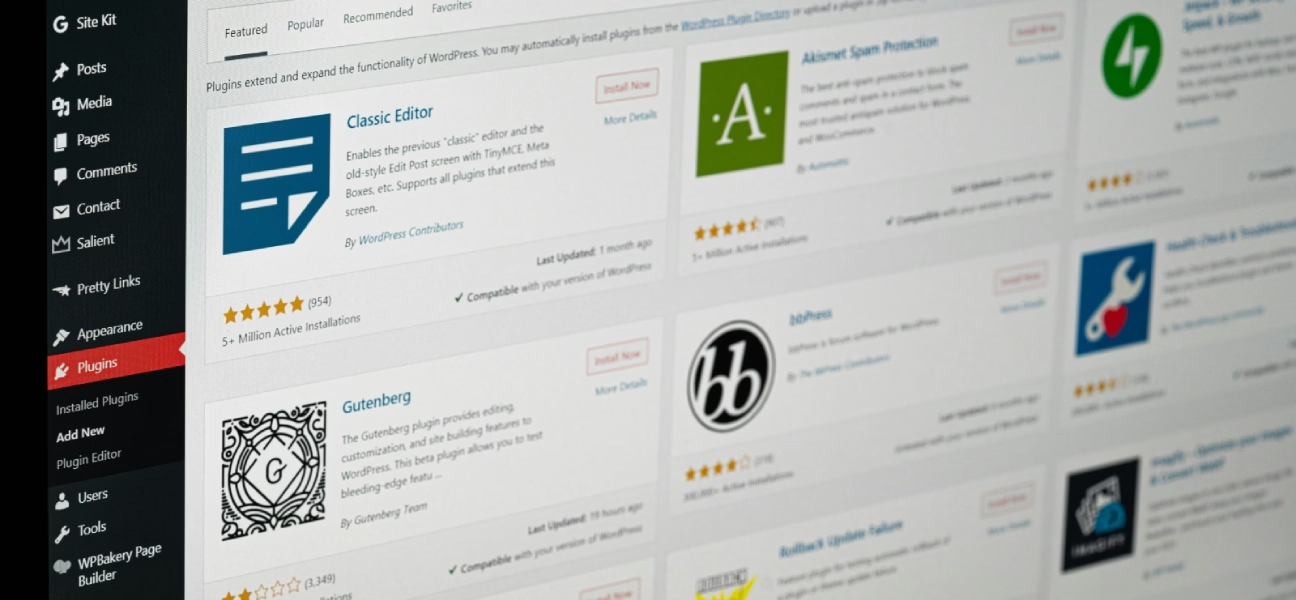
Example: WordPress.
"Open Source" means the software itself is free to use, but you are responsible for the infrastructure. Think of this as a "DIY House Kit." The timber and blueprints are free, but you must find your own land (Hosting), build the house yourself, and handle your own security.
Examples: React, Next.js.
This is the traditional route of building from scratch with raw code. There are no "builders" here. A team of developers writes every line of code to create a bespoke application.
Note: The following section analyzes the commercial and technical implications of these tools. It is intended for business owners and decision-makers evaluating ROI and long-term growth.
While "ease of use" is a valid metric for a hobbyist, a business must evaluate its infrastructure based on Efficiency, Security, and Revenue Potential.
For any growing business, time is the most finite resource. The primary cost of a website is rarely the software subscription, but the "Time Cost" required to manage it.
A pervasive myth in the SMB sector is that managing your own site on a DIY platform saves money. However, data from 2024–2026 reveals a "Time Black Hole" where business owners lose valuable hours to low-value maintenance tasks.
Security is a major differentiator between SaaS builders and Open Source systems.
As we move deeper into 2026, we are entering the age of Answer Engine Optimization (AEO). Search behaviors are shifting from traditional link-clicking to AI-generated answers (via tools like ChatGPT Search or Google Gemini).
Which tool fits your business stage? Use this matrix to identify your ideal infrastructure.
A website builder is a tool, but your choice of infrastructure is a business decision.
For a startup validating an idea, a simple DIY builder is the perfect launchpad. However, as a business matures—whether you are a local clinic, a law firm, or a growing agency—the "hidden costs" of DIY often become unsustainable. Time lost to maintenance, security risks, and missed leads due to slow speeds are liabilities no scaling business can afford.
In 2026, the goal for a growing SMB is to move from "Building it Yourself" to "Managed Infrastructure." This ensures your digital presence is an asset that generates revenue, rather than a liability that consumes time.

Discover key factors affecting Google Ads costs in 2025, from bidding & Quality Score to keyword competitiveness. Optimize budget & boost ROI effectively.
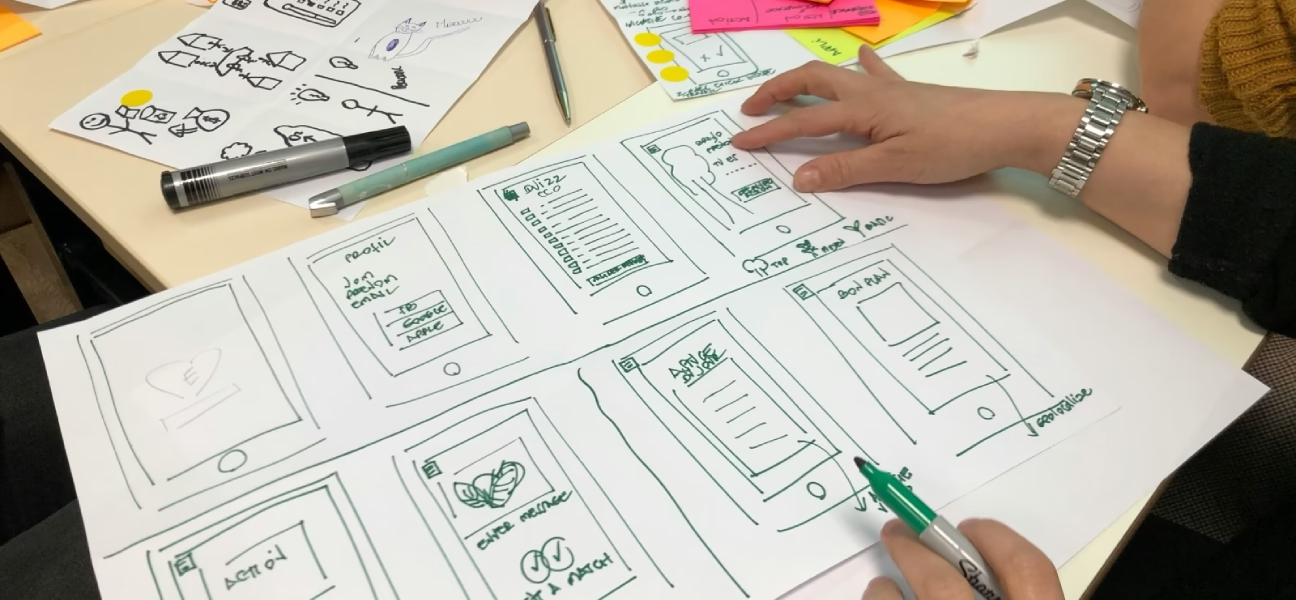
Thinking of a website redesign? Discover key reasons, cost insights, and expert tips to improve performance, UX, and branding for lasting business growth.