

How Much Do Google Ads Cost in 2025?
Discover key factors affecting Google Ads costs in 2025, from bidding & Quality Score to keyword competitiveness. Optimize budget & boost ROI effectively.
March 26, 2026
In the digital economy, confusion is the most expensive mistake a business can make.
We often assume that to beat the competition, we need to be cleverer, wittier, or more poetic than them. We spend weeks agonising over "catchy" slogans and abstract visuals, believing that sophistication equals sales.
But the data tells a very different—and much harsher—story.
When a potential client lands on your website, a mental stopwatch begins. 5... 4... 3... 2... 1. If they don't understand exactly how you help them within 5 seconds, they are gone.
They don't leave because your product is bad. They leave because your message is exhausting. Here is the commercial reality of why clarity always beats creativity, and how ambiguity is quietly draining your marketing budget.
We like to think our customers are rational decision-makers who read our content from top to bottom. In reality, they are ruthless scanners.
Research indicates that users form an opinion about your website’s credibility in just 0.05 seconds (50 milliseconds). Before they have read a single word, their brain has already decided if you are "high value" or "high effort."
If your hero section (the top part of your homepage) is cluttered or vague, the user's brain tags it as "too hard." In an era where attention spans have dropped to approximately 8 seconds—less than that of a goldfish—the "Back" button is the most used feature in web browsing.
You are not just fighting for their money; you are fighting for their metabolic energy. Every second they spend decoding your "clever" headline is energy they aren't spending on buying your service.
Why do smart business owners write confusing copy? It’s not a lack of writing skill; it’s a psychological blind spot known as the Curse of Knowledge.
In 1990, a Stanford University experiment divided people into "Tappers" and "Listeners." Tappers were asked to tap out the rhythm of a famous song (like Happy Birthday) on a table. Listeners had to guess the song.
Why the disconnect? Because the Tappers could hear the melody in their heads. The Listeners heard only disjointed thuds.
You are the Tapper. You know your business inside out. When you write a headline like "Empowering Synergistic Futures," you hear the melody of your years of hard work and expertise.
Your customer is the Listener. They just hear thuds. They have no context.
To fix this, you must stop speaking "Internal Language" (features, jargon) and start speaking "Customer Language" (pain, results).
You might worry that using simple language makes your brand look unsophisticated. The opposite is true. Complexity breeds suspicion; clarity breeds trust.
Let’s look at the hard data from the industry's leading experiments:
The lesson? If your website requires a PhD to understand, you are actively lowering your conversion rate.
Ambiguity isn't just a design flaw; it is a revenue leak.
In the B2B sector, average bounce rates (visitors who leave immediately) hover between 30% and 55%. If you are running Google Ads or Meta Ads, a high bounce rate means you are paying for traffic that effectively bounces off a brick wall.
Consider this commercial calculus:
By simply clarifying your message and dropping the bounce rate to 40%, you effectively double the efficiency of your ad spend without increasing your budget. Clarity is the highest-ROI lever you can pull.
At Seniia, we don't believe in "wordsmithing." We believe in architectural clarity. When we build a Digital Roadmap or a Brand Strategy, we force the messaging through a strict three-step filter:
Here is my challenge to you. Open your website right now. Read the headline.
If your friend outside your industry cannot explain exactly what you sell within 5 seconds of looking at it, we need to talk.
You don't need to be a poet to build a successful business. You just need to be clear.
Ready to stop losing revenue to confusion? Book a Strategy Session with Liam to audit your commercial messaging.

Discover key factors affecting Google Ads costs in 2025, from bidding & Quality Score to keyword competitiveness. Optimize budget & boost ROI effectively.
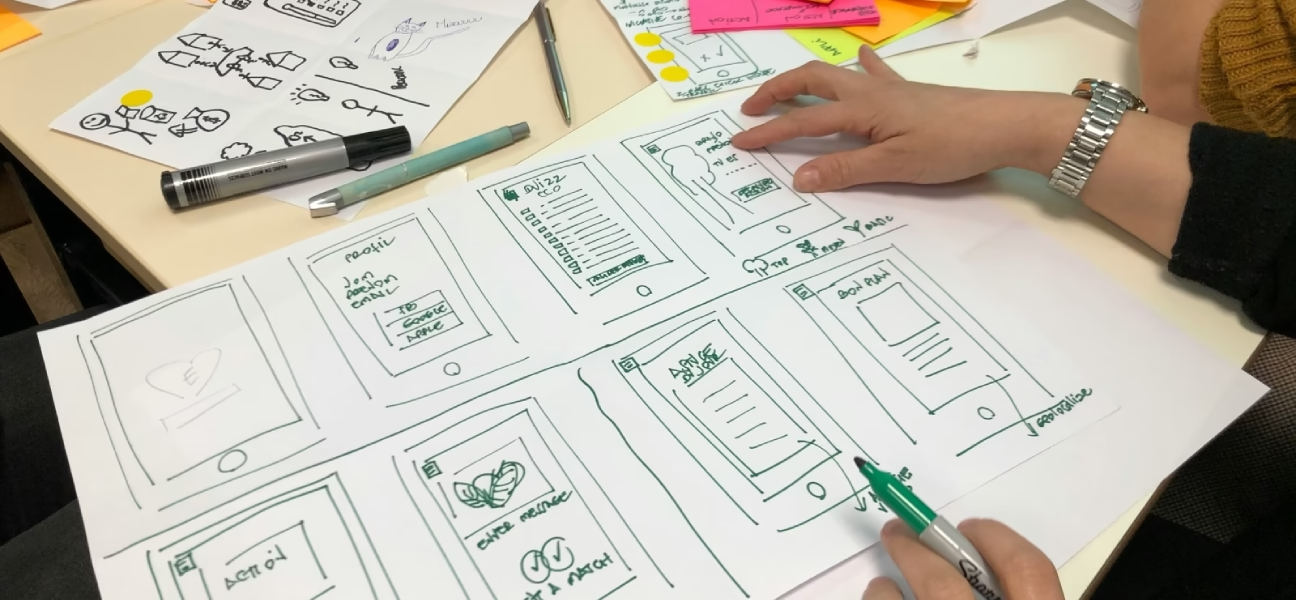
Thinking of a website redesign? Discover key reasons, cost insights, and expert tips to improve performance, UX, and branding for lasting business growth.
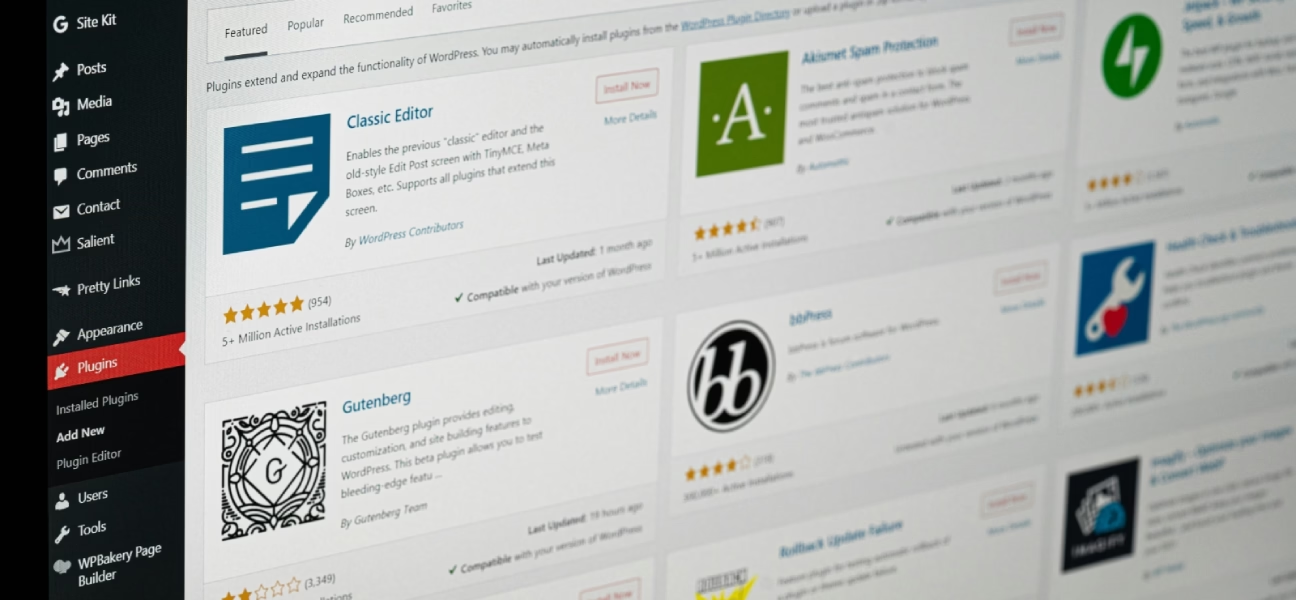
Compare top website builders like WordPress, Webflow, Wix & Shopify. Discover pros, cons, and the best fit for your business, plus custom site options with us.